
Rachel Botsman stands as one of the world’s leading thinkers on trust, technology, and how we navigate credibility in an increasingly digital era. From pioneering the language around the sharing economy to shaping global conversations on trust shifts, she has become a defining voice for leaders, companies, and institutions seeking to understand the foundations of trustworthy systems.
Who Is Rachel Botsman?
Rachel Botsman is a globally recognized author, lecturer, and researcher known for her groundbreaking work on trust in the modern world. Her ideas on collaborative consumption and distributed trust helped shape the rise of platforms like Airbnb and Uber, and her books are taught in universities and leadership programs around the world.
Her TED talks have been viewed more than 5 million times, her work has been translated into roughly 15 languages, and she has been profiled and published in Time, the New York Times, the Wall Street Journal, Wired, Harvard Business Review, and the BBC.
Rachel has served as the first Trust Fellow at Oxford’s Saïd Business School where she taught courses on trust in the digital age and the collaborative economy. She continues as an Associate Fellow, teaching senior leaders, MBA students, and executives how trust shapes behavior, decision making, and technology.
She is also the writer and curator of the popular newsletter “Rethink,” with around 85,000 subscribers, and maintains an active presence on LinkedIn, Substack, and Instagram.
Her mission?
“To help people rethink how trust works and how to design systems, products, and cultures that earn it.”
From Trust Curiosity to Global Influence
Rachel’s journey began with a question that many businesses overlook: how do people decide whether to trust something new? This curiosity led her to explore the societal and technological shifts that were making institutions less central to trust, while platforms, algorithms, and individuals were becoming more influential.
Her early work on collaborative consumption introduced a new vocabulary for the rising sharing economy. It explained why people were suddenly willing to rent homes to strangers, ride in other people’s cars, and trust digital platforms with personal and financial information.
This research evolved into a deeper examination of what she calls the Trust Shift, a transition where people increasingly place faith in individuals and technologies over traditional authorities.
Her insights became the foundation of her books:
What’s Mine Is Yours on collaborative consumption
Who Can You Trust? on trust and technology
How to Trust and Be Trusted released as an audio experience in 2024
Rather than staying within academia, Rachel expanded her reach through keynote talks, exhibitions, podcasts, and storytelling formats that blend research with visuals, drawings, and experiential design. Her installation “Roots of Trust” is one example of her creative approach to making complex ideas feel human and accessible.
Mission: Redesigning Trust for the Age of AI
In her current work, Rachel focuses heavily on trust and artificial intelligence. She argues that the real challenge is not whether AI can perform tasks, but whether it earns trust through its design, behavior, and transparency.
She teaches leaders that trust cannot be demanded or extracted. It must be earned through clarity, communication, and responsible systems.
Her frameworks have become core tools for businesses and policymakers who want to understand:
how trust is built, broken, and repaired
when people are likely to take a trust leap into something unfamiliar
how reputation capital influences behavior on platforms
how to design AI systems that are trustworthy, not simply efficient
Her global clients include Fortune 500 companies, major governments, and leading universities.
Themes and Message Pillars
1. The Trust Shift
Rachel maps how trust is moving away from institutions and into the hands of platforms, individuals, and algorithms, with massive implications for society and governance.
2. Trust Leaps
She explains why people take big leaps of faith with new technology, and what design principles make these leaps possible.
3. Reputation as Currency
Rachel argues that reputation capital is becoming as important as financial capital in digital ecosystems.
4. Designing for Trust
Her frameworks help leaders build cultures, products, and AI systems that earn trust through actions and transparency.
5. Storytelling through Experience
Rachel blends research with visual art, installations, and sketches to make trust tangible and relatable.
LinkedIn Content Strategy: Trust Thought Leadership at Work
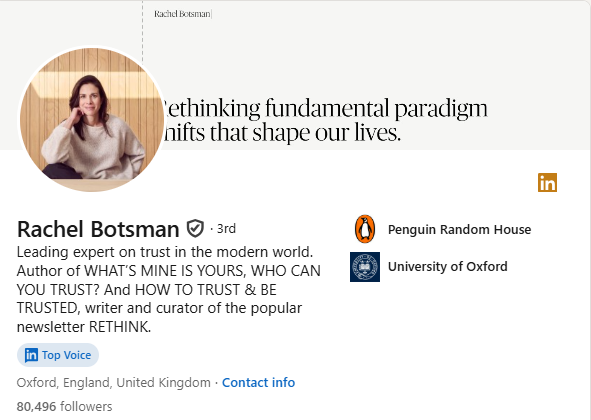
On LinkedIn, Rachel’s writing blends deep insight with clarity, visual storytelling, and relatable examples from everyday life. She uses narrative, research-based frameworks, and reflective prompts to help leaders rethink how trust functions in their teams, products, and decision
making.
Strategy Highlights
Educational Models: Frameworks that break down complex ideas such as the lifecycle of trust, distributed trust, and trust leaps.
Visual Storytelling: Hand drawn diagrams and sketches that simplify abstract ideas.
Real World Examples: Stories from companies, students, and technology shifts that illustrate how trust behaves in practice.
AI and Trust: Practical guidance for building AI systems that earn trust through clarity and design, not opacity or authority.
Some of her Posts
"I earn trust by walking the line between the things people expect and don’t expect."
When we talk about trust in AI, are we really talking about trust – or are we talking about risk?
Media Appearances:
Tone and Style
Calm, reflective, and thoughtful
Research driven but always human
Designed to provoke deeper thinking rather than quick reactions
Why Rachel Botsman Matters?
Rachel Botsman represents a new generation of thinkers who help society navigate the blurred lines between people, platforms, and technology. Her work shows that trust is not soft or abstract, it is the operating system of every relationship, organization, and technology we depend on.
As the world enters a new era shaped by artificial intelligence and digital platforms, Rachel’s insights matter more than ever. She teaches leaders that trust is earned through consistent behavior, clear communication, and ethical design, and that without trust, innovation cannot scale in a healthy or sustainable way.
In her own words, trust is not a feeling, it is a confident relationship with the unknown.
Profile Summary
Info | Detail |
Name | Rachel Botsman |
Title | Author, Lecturer, Leading Expert on Trust |
Focus | Trust in technology, AI, collaborative consumption, reputation systems |
Experience | Global author, TED speaker with 5M plus views, Oxford Saïd educator, Fortune 500 advisor |
Platform Reach | 80K LinkedIn followers, 85K newsletter subscribers, millions of media impressions |
Notable Achievements | First Trust Fellow at Oxford Saïd, Thinkers50 recognition, TED talks, global keynote speaker |
Website |
LinkedIn Profile