
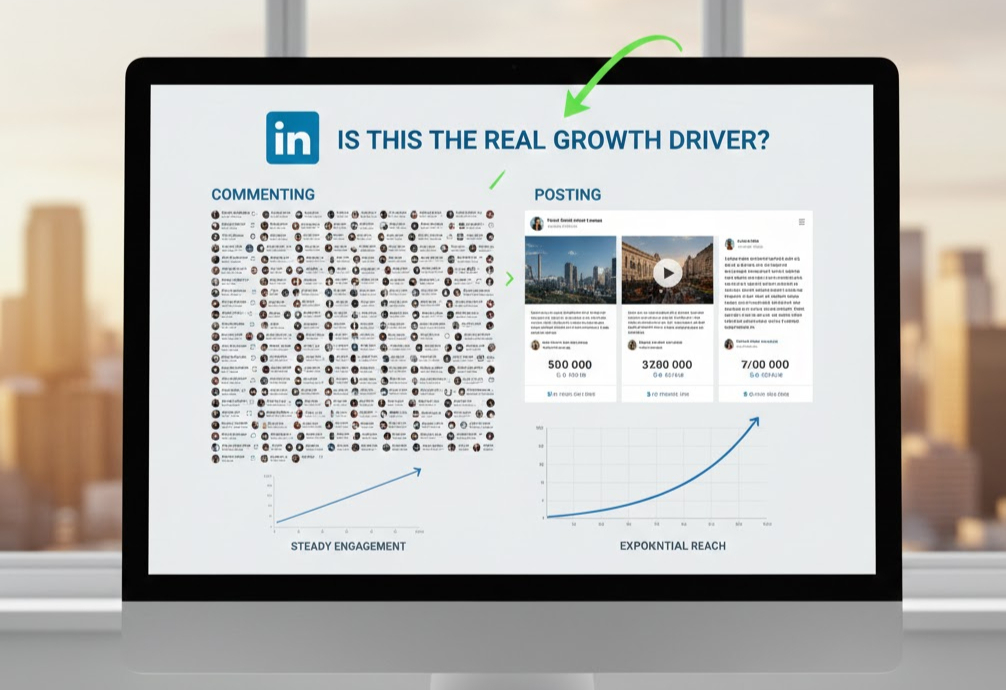
If you’ve ever found yourself hunched over your phone chasing the “top comment” on a viral post on LinkedIn, frantically refreshing for replies, trying to craft the perfect flattery or provocative take just to get noticed, you’re not alone. But if you're building a product (say, your own SaaS) or growing a consulting business, you've got to pause: Is this really the smartest way to spend your time?
Here’s a grounded look at what commenting vs posting on LinkedIn actually drives, plus a simple framework you can commit to, without burning yourself out. I’ll also share practical tactics you can use right away.
What Commenting Vs Posting On LinkedIn Is Good For (and Where It Falls Short)
The upside of commenting
When you comment with intention, you get immediate visibility. If you spot the right post (timing + relevance), your name pops up in front of a large audience quickly. You can also build warm connections by showing up thoughtfully for creators, prospects, or potential collaborators. Over time, if you show up consistently and meaningfully, you begin to “borrow trust” from bigger names, the “Oh yeah, I’ve seen them around” effect.
Commenting also keeps you in the game. You’re active in your niche, you’re seeing what others are saying, and you’re getting ideas and inspiration for your own content.
The limitations of commenting
But here’s the catch: comments don’t necessarily compound. Most comments fade away in 24-48 hours unless someone DMs you right away. They rarely scale unless you pour huge time into them (and risk burnout). And comments by themselves don’t build deep authority. Most people don’t click through your profile from a comment unless it’s exceptionally insightful and your headline is clear.
So if commenting is all you do, you may feel like you’re running on a treadmill, moving fast but not really getting farther.
Why Posting on LinkedIn Is the Better Compounding Asset
When you publish your own content on LinkedIn, you’re building a library of thinking, a set of posts that can work for you weeks or months later. Posting helps you:
Signal your expertise to prospects who are quietly checking you out (yes, “lurkers” count).
Create content others can reference (“Did you see that post they wrote about X?”).
Escape the notification-chasing race of “Who’s going to reply first”.
Don’t misread this: I’m not saying “never comment.” Instead: comments should support your content strategy, not replace it.
A Simple Time Model: The “70/20/10” Split
If you’re feeling stretched (and you likely are, if you’re building a product or consulting pipeline), try this weekly focus:
70% of your time > Posting & content operations
20% of your time > Relationship-building: comments + DMs
10% of your time > Discovery & calibration (what worked, what didn’t, ideation)
What that looks like
3-4 posts per week (approximately 30-60 minutes each)
20-30 minutes per day of intentional commenting + DM follow-ups
45-60 minutes per week to review analytics, gather proof points, plan your next week
Practical Steps: Posting That Actually Works
1. Pick your content pillars
Rotate between 3-5 themes you can reliably produce. Examples:
A problem > solution breakdown in your niche
A “what I learned” post: frameworks, checklists, templates
A contrarian but honest industry take (without outrage bait)
Behind-the-scenes of your build or process
Proof & outcomes: mini-cases, numbers, screenshots with context
2. Use a clear structure
For each post:
Hook: 1-2 lines stating the pain or problem
Body: 3-7 concise points, each with a micro-insight or example
Close: Clear next step (invite comment, share a resource, DM for details)
Visual: If you can, include a clean diagram, carousel/slides, or screenshot
3. Cadence > Volume
Three strong posts per week beat seven rushed ones. If one explodes, reuse it later in a new format (e.g., turn it into a carousel or “Part 2”). Use a tool stack to batch draft, schedule, and polish so you’re not scrambling.
4. Track meaningful analytics
Profile views & new follows per post (good proxy for authority)
Saves & shares (shows compounding potential)
DMs and lead-signals (real conversations > likes)
Impressions are useful, but only as context, focus on what moves deals.
Intentional Commenting
When you do comment, make it count.
Where to comment
On posts by niche creators whose audience overlaps with your ideal client
On posts by potential partners (complementary service providers)
In industry conversations where your specific expertise can clarify confusion
Timing & style
Being early helps (first hour matters), but if you can’t be early, be exceptionally valuable.
Comment styles that travel:
Mini-framework: “Here’s 3 quick steps you can try today…”
Respectful counter-point: “As a caveat: here’s a use case where this structure shifts…”
Micro-case: “In our recent client build we saw X happen after… ”
Saveable list: “Here are 4 things you might miss…”
Avoid generic praise (“Great post!”) without substance. Avoid intentionally provocative comments just to get engagement. Avoid dropping links in comments unless invited — better: “DM me if you’d like the template.”
Turn comments into connections
When someone replies to your comment or engages, follow up with a DM: “Happy to share the template we used, want me to send it? ”Set aside a short list each week of people to DM. One thoughtful DM beats twenty scattershot comments.
Useful YouTube Video
Here’s a helpful YouTube walkthrough that gives strong actionable tactics for growth on LinkedIn:
Watch this for step-by-step insights you can apply directly.
Discovery & Calibration (Making Your Learning Actually Useful)
Each week ask yourself:
Which post type got me profile visits or started conversations?
Which topics got genuine replies (not just likes)?
Am I crystal clear on who I’m talking to and what problem I solve?
What objections did I hear this week that deserve their own post?
Light content calendar suggestion:
Monday: Problem-solution post (core pain point)
Wednesday: “Teach what I know” post (framework, checklist, teardown)
Friday: Proof/mini-case (numbers, outcome, screenshot)
Daily (15-30 min): Comment on 3-5 relevant posts + one DM follow-up
What If You Really Want to Chase Top Comments?
If you enjoy that game and want to experiment:
Pick 2-3 big accounts that consistently attract your ideal client.
Turn on notifications.
Carve two 10-15 minute windows each day to jump in.
Pre-draft one or two “first lines” (so you’re ready).
After two weeks track: how many profile visits? How many new follows? How many DM starts? If it's not yielding returns, back off.
Automation? Use it only to manage the backend (collections, reminders). Don’t automate comments with your name, that risks your account and reputation.
The Blended Path That Actually Works
Lead with original posts that build your thinking library. Use comments purpose-fully to open doors and start conversations, not as your only strategy. Measure what matters: profile intent, real conversations, pipeline momentum. And above all: build something you can sustain.
In short: Commenting isn’t bad, it just demands expensive attention. Posting is patient attention. For most builders, consultants and founders, a steady posting habit supported by smart comments beats chasing the “top comment” treadmill.
Quick Checklist You Can Steal
Audience clarity: Who am I for? What wake-up problem do they have?
Message: What 3-5 ideas do I want to be known for?
Proof: What case studies, screenshots or numbers will I share this month?
Cadence: What can I commit to for the next 6-8 weeks + not burn out?
Comment targets: Which 10 creators/accounts are worth showing up for?
CTA habit: What’s the next action I’m inviting (comment, DM, resource)?
FAQ prompts to refine your approach:
If I skipped commenting for a week, would my pipeline change? If yes, am I too reliant on borrowed attention?
Which post could I expand into a downloadable resource or lead magnet this month?
What’s the simplest “offer mention” I can make without being pushy? (“DM me ‘template’ and I’ll send it.”)
Which 2 posts from others taught me something real this week? What does that say about my own content?
Final Thought
If you go back to the root: What do you want from LinkedIn? More leads? Credible conversations? Growing presence in your niche? Then focus on the strategy that moves those things.
Posting builds a foundation. Commenting opens doors. Make them work together, not against you.
For more useful insights, visit our blog and follow us on LinkedIn: