Real Issue: LinkedIn Feels Like a Stage, not a Conversation
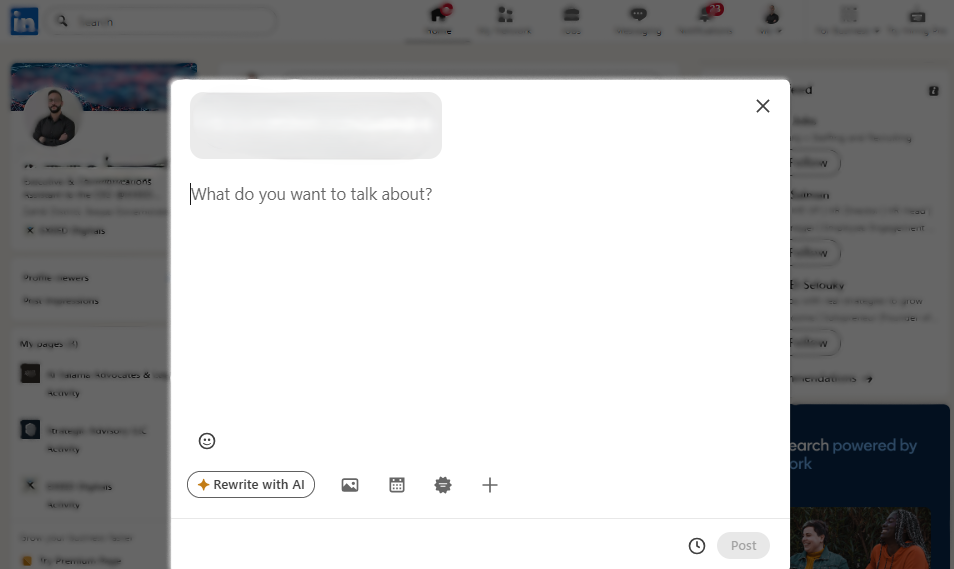
If you’ve ever opened the Start a post box and immediately felt blank, you’re not alone. Many people write well in daily life, emails, reports, and presentations, but posting on LinkedIn suddenly feels like performing.
In normal conversations, you respond to questions, discuss problems, or share updates. Online, that context disappears, and you’re left with:
Say something smart to everyone who’s ever known you… Plus future employers.
A helpful mindset shift
Ask yourself:
If a colleague asked me this over coffee, what would I say?
Start from that tone, your authentic voice.
For conversational writing examples, this breakdown is useful
What Am I Known For? Feels Heavy, So We Avoid Posting
Being known for something can feel like an identity you must have fully figured out. But you don’t need a polished personal brand; you need a point of view.
Try this quick framework:
I want to be known for helping [who] with [what outcome] using [how].
Example:
I want to be known for helping new managers build trust through consistent communication.
Your point of view can evolve; most people refine theirs as they grow.
You’re Searching for the Perfect Angle Instead of Using Repeatable Formats
A major cause of stress related to LinkedIn posting is decision fatigue. You feel like each post must be original in both idea and structure.
Instead, create 3-5 content buckets you can rotate through:
Lesson learned
Simple how-to
Myth vs. reality
Behind the scenes
Opinion with nuance
When you use buckets, the question becomes:
Which bucket am I writing from today?
Not what should I post?
For more on content thinking and professionalism, LinkedIn’s official blog is helpful
The Cringe Feeling Comes from Borrowing Someone Else’s Voice
People often imitate high-performing posts, dramatic hooks, or overly bold tones. That mismatch makes the writing feel forced.
A practical rule:
Write the way you speak, then edit for clarity, not virality.
If you worry about sounding promotional, shift the framing:
• Instead of Look at me, try Here’s something that may help you.
• Instead of I know everything, try Here’s what I’m learning.
You’re Afraid of Being Judged by Multiple Audiences at Once
Your followers could include coworkers, former classmates, clients, recruiters, and industry peers. That wide mix often leads to trying to please everyone and ending up sounding generic.
Fix:
Write to one default reader.
Examples:
• A junior colleague in your field
• A peer at another company
• A busy founder who needs things to be concise
• A hiring manager who wants to understand how you think
When you write to one person, you sound more human naturally.
You’re Overestimating How Original Your Ideas Must Be
You don’t need brand-new concepts. You just need your lived version of them.
Your unique value often lives in:
• Your examples
• Your tradeoffs
• You solved mistakes
• You're what I’d do differently next time
A simple prompt that works forever:
What’s something I understand now that I didn’t understand 12 months ago?
A Simple Posting Process to Make LinkedIn Easier
Here’s a low-friction workflow:
Step 1: Capture quick notes during the week
Use Notes or Notion. Record:
• Questions people asked you
• Decisions you made
• Mistakes you fixed
• Frameworks you used
Step 2: Turn one note into a post with this structure
Context → Point → Breakdown (3 bullets) → Question
Simple, natural closing questions include:
• How do you handle this?
• What would you do differently?
• Is this common in your industry too?
Step 3: Keep it intentionally short
Great LinkedIn posts are clear and not long.
Tools that can help:
Read more on our blog and follow us on LinkedIn: